
Your skin is the largest organ in your body — and most people are treating it completely wrong. If you’ve been slapping on moisturizer and calling it a day, a proper beginner skincare routine could genuinely transform your complexion in as little as four weeks.
This guide breaks down everything you need to know: the exact steps, the right products, the order that actually matters, and the mistakes that are silently sabotaging your skin. Whether you’re a total beginner or someone who’s tried “everything” without results, this is where you start.
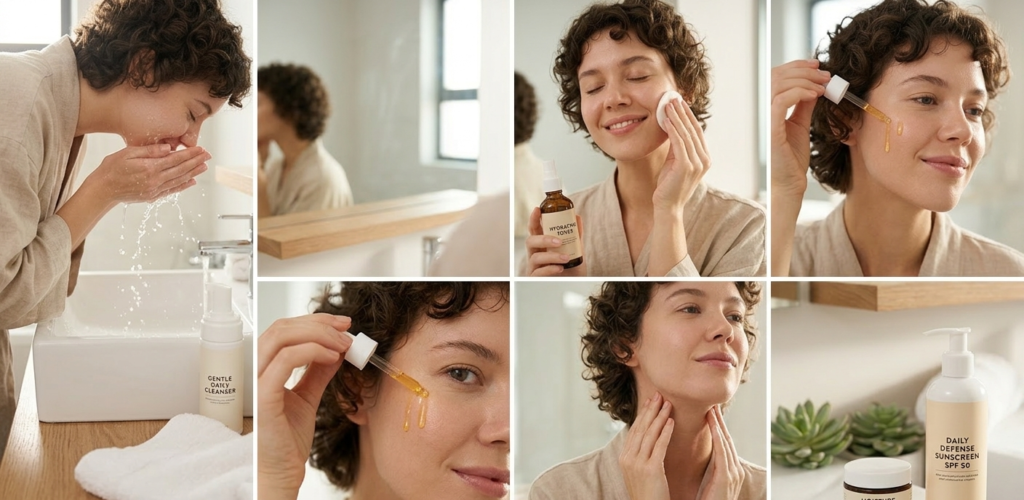
Table of Contents
ToggleWhat Is a Beginner Skincare Routine?
A beginner skincare routine is a simple, consistent set of daily habits designed to cleanse, protect, and nourish your skin. It doesn’t need to be complicated — in fact, the best beginner routines use just three to five products applied in the correct order.
Think of it less like a beauty ritual and more like brushing your teeth. You don’t think about why you brush your teeth each morning — you just do it, because consistency is what produces results.
The core pillars of any beginner skincare routine are:
- Cleansing – removing dirt, oil, and impurities
- Treating – addressing specific concerns like acne, dullness, or dryness
- Moisturizing – locking in hydration and repairing your skin barrier
- Sun protection – preventing premature aging and skin damage
Everything else — serums, toners, masks, eye creams — is optional enhancement. The four steps above are non-negotiable.
Why Your Skincare Routine Actually Matters
Here’s something dermatologists say that surprises most people: how you take care of your skin in your 20s and 30s directly determines how it looks in your 40s and 50s.
Sun damage, for example, accounts for up to 90% of visible skin aging. A simple daily SPF habit, started early, can prevent decades of wrinkles, dark spots, and uneven texture.
Beyond anti-aging, a solid beginner skincare routine can:
- Reduce acne breakouts by keeping pores clear and balancing oil production
- Improve skin texture and brightness within 4–6 weeks of consistency
- Strengthen your skin’s moisture barrier, reducing sensitivity and redness
- Build self-confidence — the way your skin looks genuinely affects how you feel
The catch? Most people quit before they see results, or they use the wrong products for their skin type. This guide fixes both.
Know Your Skin Type Before You Start
Before you buy a single product, you need to understand your skin type. Using the wrong products is the #1 reason beginner skincare routines fail.
Here’s a simple at-home test: wash your face with a gentle cleanser, pat dry, wait 30 minutes without applying anything, then observe.
| What You Notice | Skin Type |
|---|---|
| Face looks shiny all over | Oily |
| Tight, flaky, or uncomfortable | Dry |
| Shiny T-zone (forehead, nose, chin), normal cheeks | Combination |
| Redness, stinging, or reacts easily to new products | Sensitive |
| None of the above — balanced and comfortable | Normal |
Once you know your skin type, you can choose products that actually work with your skin instead of against it.
The Beginner Skincare Routine Step by Step
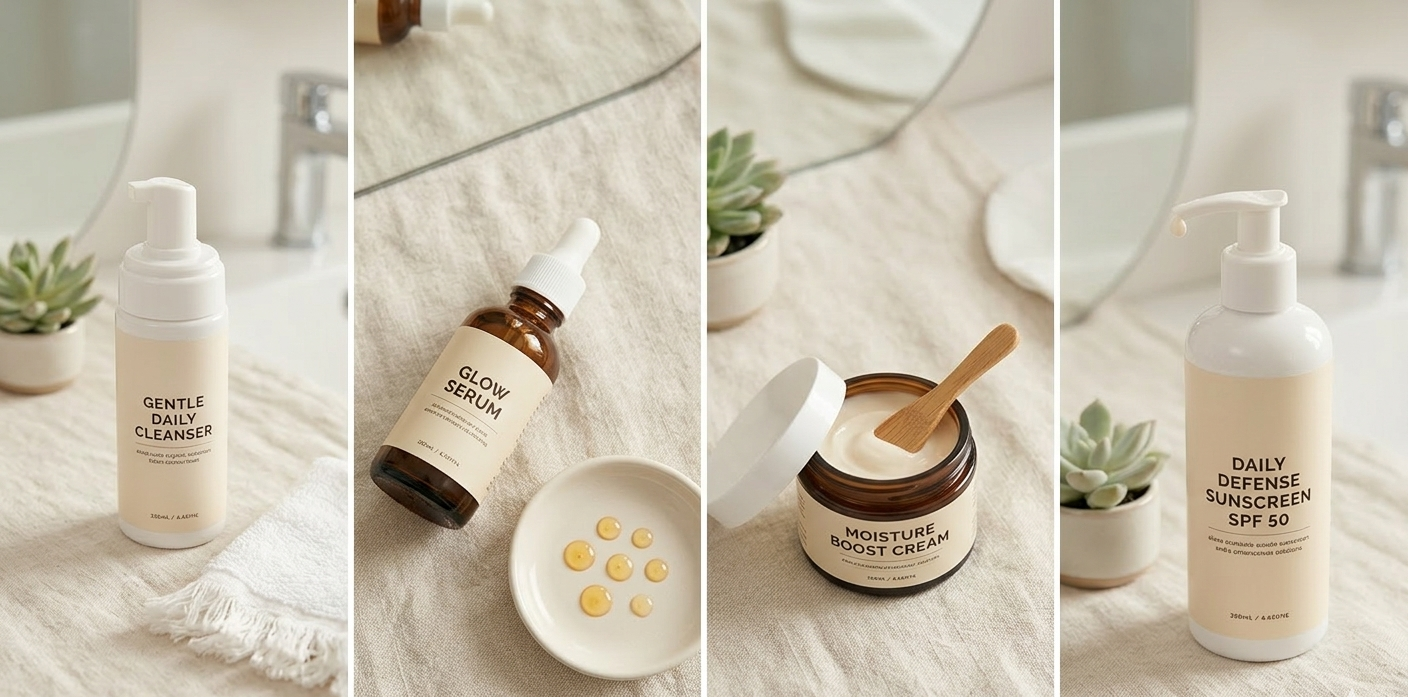
Here it is — the exact routine, explained clearly, for both morning and night.
if You want simplest skin care routine here are various
Morning Routine
Step 1: Cleanser
What it does: Removes overnight oil buildup, sweat, and any residue from your night products.
How to do it: Use a gentle, sulfate-free cleanser. Wet your face with lukewarm water (not hot — hot water strips your skin barrier). Apply a small amount, massage in gentle circular motions for 30–60 seconds, then rinse thoroughly.
Recommended for beginners:
- Oily/combination skin: Foaming or gel cleansers (look for salicylic acid)
- Dry/sensitive skin: Cream or micellar cleansers (look for ceramides or glycerin)
Pro tip: You don’t always need to use cleanser in the morning. If your skin is dry or sensitive, splashing with lukewarm water is enough — your face isn’t that dirty when you wake up.
Step 2: Toner (Optional)
What it does: Balances your skin’s pH after cleansing and preps skin to absorb the next products better.
How to do it: Apply a few drops to a cotton pad or your palms and press gently into skin. Don’t rub.
Modern toners aren’t the harsh, alcohol-filled astringents of the 90s. Look for hydrating toners with ingredients like hyaluronic acid, niacinamide, or rose water.
Skip it if: You’re just starting out and want to keep your beginner skincare routine simple. It’s the most optional step.
Step 3: Serum (Optional but Powerful)
What it does: Delivers concentrated active ingredients deep into the skin to target specific concerns.
How to do it: Apply 2–4 drops to your fingertips and press gently into your face and neck. Use before moisturizer.
The best beginner serums by concern:
| Concern | Ingredient to Look For |
|---|---|
| Dullness / uneven skin tone | Vitamin C (apply in the morning) |
| Acne / large pores | Niacinamide |
| Dryness / fine lines | Hyaluronic Acid |
| Dark spots | Alpha Arbutin or Kojic Acid |
Start with just one serum — layering too many actives is a common beginner mistake that leads to irritation.
Step 4: Moisturizer
What it does: Hydrates the skin, seals in previous products, and strengthens your skin barrier.
How to do it: Apply a pea-to-dime sized amount and gently press or smooth into skin. Don’t skip this step even if you have oily skin — dehydrated skin actually produces more oil to compensate.
- Oily skin: Lightweight, water-based gel moisturizers
- Dry skin: Richer creams with shea butter, ceramides, or squalane
- Sensitive skin: Fragrance-free formulas with minimal ingredients
Step 5: Sunscreen (Non-Negotiable)
What it does: Protects your skin from UVA (aging) and UVB (burning) rays — the leading cause of premature aging, dark spots, and skin cancer.
How to do it: Apply a generous amount (about a teaspoon for your face and neck) as the last step of your morning routine. Reapply every 2 hours if outdoors.
“For All skin specifically, see our [best sunscreen for All skin in India under ₹500] picks.”
Choose:
- SPF 30 at minimum (SPF 50 is better)
- Broad-spectrum coverage (UVA + UVB)
- Formula suited to your skin type (gel for oily, cream for dry)
This is the single most evidence-backed skincare step in existence. If you do nothing else from this beginner skincare routine, do this.
Evening Routine
Your nighttime beginner skincare routine is where the real repair work happens. Skin cell turnover peaks between 11 PM and 4 AM — the right products applied at night supercharge this process.
Step 1: Double Cleanse (If You Wore Makeup or SPF)
What it does: Removes oil-based impurities (makeup, SPF, pollution) that water-based cleansers can’t fully dissolve.
How to do it:
- First cleanse: Apply a cleansing balm or micellar water to dry skin. Massage gently, then rinse.
- Second cleanse: Follow with your regular gentle cleanser.
If you didn’t wear makeup or SPF, a single cleanse is fine.
Step 2: Exfoliant (2–3x Per Week Only)
What it does: Removes dead skin cells that clog pores and dull your complexion.
There are two types:
- Chemical exfoliants (recommended for beginners): AHAs like glycolic or lactic acid dissolve the bonds between dead skin cells gently. BHAs like salicylic acid go deeper into pores — ideal for acne-prone skin.
- Physical exfoliants (use with caution): Scrubs with beads or grains. These can cause micro-tears if too harsh.
Important: Do NOT exfoliate every day. Over-exfoliation is one of the most common beginner skincare mistakes and leads to redness, sensitivity, and a damaged skin barrier.
Step 3: Toner / Essence (Optional)
Same as the morning step — hydrating toners can be applied here if you choose to use one.
Step 4: Treatment Serum
What it does: Nighttime is the best time to use more powerful actives that may increase sun sensitivity.
Top beginner-friendly night serums:
- Retinol — the gold standard anti-aging ingredient. Start with 0.025% or 0.05% to minimize irritation. Use only at night, 2–3x per week to start.
- Niacinamide — brightens, reduces pores, calms inflammation. Can be used morning and night.
- Peptides — support collagen production and skin elasticity.
Note: Don’t combine retinol with AHA/BHA exfoliants in the same routine — this is a recipe for irritation.
Step 5: Eye Cream (Optional)
What it does: The skin around your eyes is 10x thinner than the rest of your face and needs targeted hydration.
How to do it: Apply a small amount (rice grain size) with your ring finger — it applies the least pressure — and gently tap (don’t rub) around the orbital bone.
Step 6: Moisturizer / Night Cream
Same as the morning step, but you can go heavier at night. Look for creams with ceramides, peptides, or hyaluronic acid for overnight repair.
Step 7: Facial Oil or Occlusive (Optional)
A few drops of facial oil (rosehip, jojoba, squalane) or a thin layer of petroleum jelly on top seals everything in and prevents overnight moisture loss. This technique is called “skin flooding” or “slugging” and has become popular for a reason — it genuinely works for dry skin.
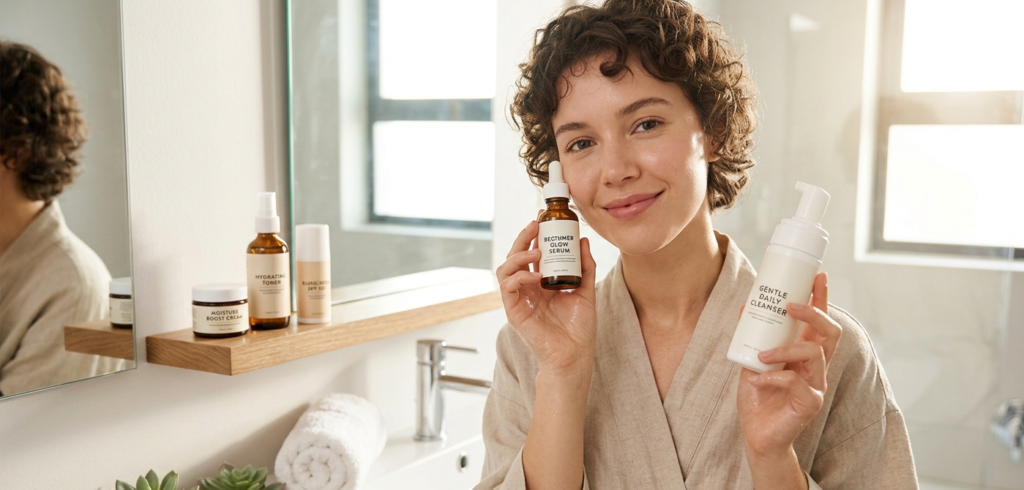
A Quick Visual Summary
| Step | Morning | Evening |
|---|---|---|
| Cleanse | ✅ | ✅ (double cleanse if wearing SPF/makeup) |
| Tone | Optional | Optional |
| Exfoliate | ❌ | 2–3x per week |
| Serum | Optional (Vitamin C) | Optional (Retinol, Niacinamide) |
| Eye Cream | Optional | Optional |
| Moisturize | ✅ | ✅ |
| Sunscreen | ✅ Always | ❌ |
| Facial Oil | ❌ | Optional |
Common Beginner Skincare Mistakes
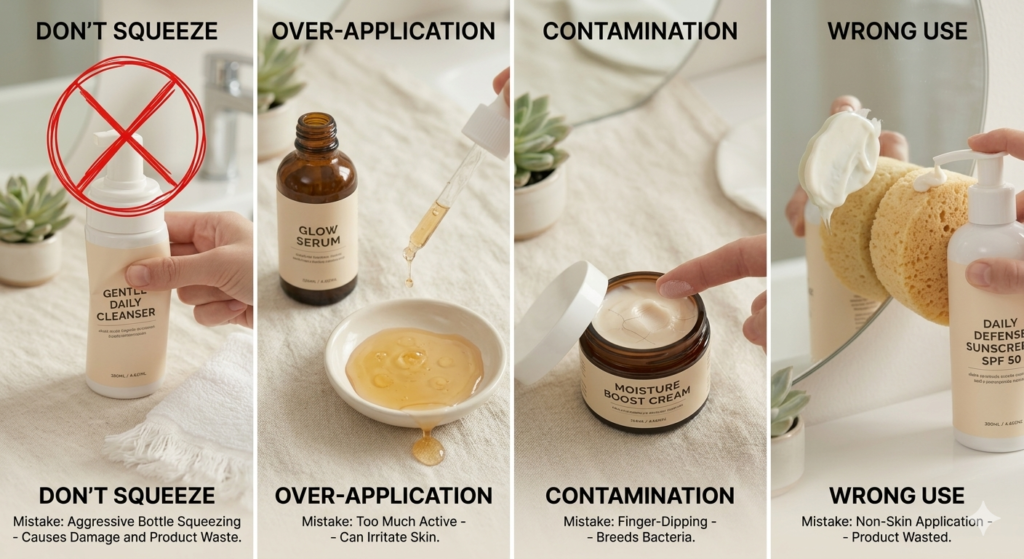
Even with the best beginner skincare routine, these errors can stall your progress. Avoid them.
1. Using Too Many Products at Once
The beauty industry wants you to buy everything. Resist. When you introduce multiple new products simultaneously, you can’t identify what’s working — or what’s causing a breakout. Add one new product every 1–2 weeks.
2. Skipping Sunscreen
The research is unambiguous. UV exposure causes collagen breakdown, hyperpigmentation, and DNA damage in skin cells. No serum, no matter how expensive, can undo sun damage. Sunscreen is your most important anti-aging product.
3. Over-Exfoliating
More is not better. Exfoliating daily strips your skin’s natural moisture barrier, leading to redness, sensitivity, and paradoxically — more breakouts. Stick to 2–3 times per week maximum.
4. Not Patch Testing New Products
Before applying a new product to your entire face, apply a small amount to your inner arm or jawline for 24 hours. This is especially important for people with sensitive skin or a history of allergic reactions.
5. Giving Up Too Soon
Skincare takes time. Most dermatologists recommend giving any new routine at least 6–8 weeks before judging results. Your skin’s cell turnover cycle is approximately 28 days — meaningful changes take at least one full cycle.
6. Rubbing (Instead of Patting)
Tugging and rubbing at your skin — especially around the eyes — can break down collagen and contribute to sagging over time. Always pat products gently into skin.
7. Using Hot Water
Hot water feels satisfying but damages your skin barrier and triggers inflammation. Lukewarm is always the right temperature for cleansing.
Expert Skincare Tips for Beginners
These are the tips dermatologists give their own patients — the ones that actually move the needle:
Start with the basics. Cleanser, moisturizer, SPF. Master these three before adding anything else. A simple, consistent beginner skincare routine beats a complicated, inconsistent one every single time.
Hydration is for everyone. Even oily skin needs moisture. When oily skin is dehydrated, it overproduces sebum to compensate — which leads to more breakouts. A lightweight, non-comedogenic moisturizer balances this.
Layer thinnest to thickest. The correct application order is: liquid → serum → gel → cream → oil. This ensures each product can penetrate properly.
Introduce retinol slowly. Retinol is transformative for anti-aging and acne, but beginners often use it too aggressively. Start at the lowest concentration, apply every third night, and gradually increase frequency as your skin adapts.
Your neck and chest are part of your face. These areas age at the same rate as your face but get half the care. Extend every product from your chin down.
Consistency beats perfection. One product applied consistently for three months will outperform a full 10-step routine you abandon after two weeks.
According to Dermatology these are perfect skincare for beginner
Building Your First Skincare Shopping List
Here’s what a complete but budget-friendly beginner skincare routine starter kit looks like:
Budget-Friendly Picks (Under affordable):
- CeraVe Hydrating Facial Cleanser
BUY NOW - The Ordinary Niacinamide 10% + Zinc 1%
BUY NOW - Neutrogena Hydro Boost Water Gel
BUY NOW - EltaMD UV Clear Broad-Spectrum SPF 46 (splurge-worthy — or try La Roche-Posay Anthelios for a budget option)
BUY NOW
You do not need luxury skincare to see results. Clinical research consistently shows that drugstore formulations with the right active ingredients perform comparably to high-end alternatives.
Frequently Asked Questions
1. How long does it take to see results from a beginner skincare routine?
Most people notice improvements in skin texture and hydration within 2–4 weeks. For concerns like hyperpigmentation, acne scarring, or fine lines, allow 8–12 weeks of consistent use before evaluating results. Skin cell turnover takes approximately 28 days, so meaningful changes require at least one full cycle.
2. Can I skip moisturizer if my skin is oily?
No — this is one of the most common skincare myths. Oily skin still needs hydration. When your skin is dehydrated, oil glands produce excess sebum to compensate, which can actually worsen breakouts. Use a lightweight, oil-free, non-comedogenic moisturizer instead.
3. Do I need a separate day and night cream?
Not necessarily as a beginner. The same moisturizer can often be used morning and night. The difference is that night creams tend to be richer and may contain active ingredients like retinol that aren’t suitable for daytime. As you advance your routine, you can explore dedicated night products.
4. What order do I apply skincare products?
Apply products from thinnest to thickest consistency: cleanser → toner → serum → eye cream → moisturizer → sunscreen (morning only). This order ensures each product can absorb properly without being blocked by heavier formulations.
5. Is a 10-step Korean skincare routine better than a basic 3-step routine?
Not for beginners. More steps are only better if every product serves a clear purpose for your specific skin concerns. A consistent 3-step routine (cleanse, moisturize, SPF) will outperform a sporadic 10-step routine. Start simple, then add steps deliberately based on your skin’s actual needs.
6. Can I use Vitamin C and Retinol together?
It’s generally not recommended to layer them in the same application. Vitamin C is best used in the morning (it also provides added antioxidant protection against UV damage), while retinol is best used at night. They work better separately and there’s a risk of irritation when combined.
7. Why is my skin breaking out after starting a new routine?
This is called “purging” — a temporary increase in breakouts as active ingredients like retinol or AHAs accelerate cell turnover, pushing existing congestion to the surface faster. True purging typically resolves within 4–6 weeks and only occurs with ingredients that speed up cell turnover. If your breakouts don’t resolve or occur in areas you don’t normally break out in, you may be reacting to a specific ingredient.
Final Conclusion
A beginner skincare routine doesn’t need to be intimidating, expensive, or time-consuming. The most effective routines are simple, consistent, and built around your skin type.
To recap what you’ve learned:
- Know your skin type before buying products
- Start with the essentials: cleanser, moisturizer, and SPF
- Apply products in the correct order — thinnest to thickest
- Introduce new products one at a time, every 1–2 weeks
- Give your routine at least 6–8 weeks before evaluating
- Never skip sunscreen — ever
Skin transformation is a marathon, not a sprint. The people with the best skin in their 40s and 50s are the ones who started taking care of it consistently in their 20s and 30s — with simple, evidence-backed habits.
Start tonight. Wash your face, moisturize, and set a reminder to apply SPF in the morning. That’s your first step.